UAE Equal Pay Law: Employee Rights and Employer Obligations
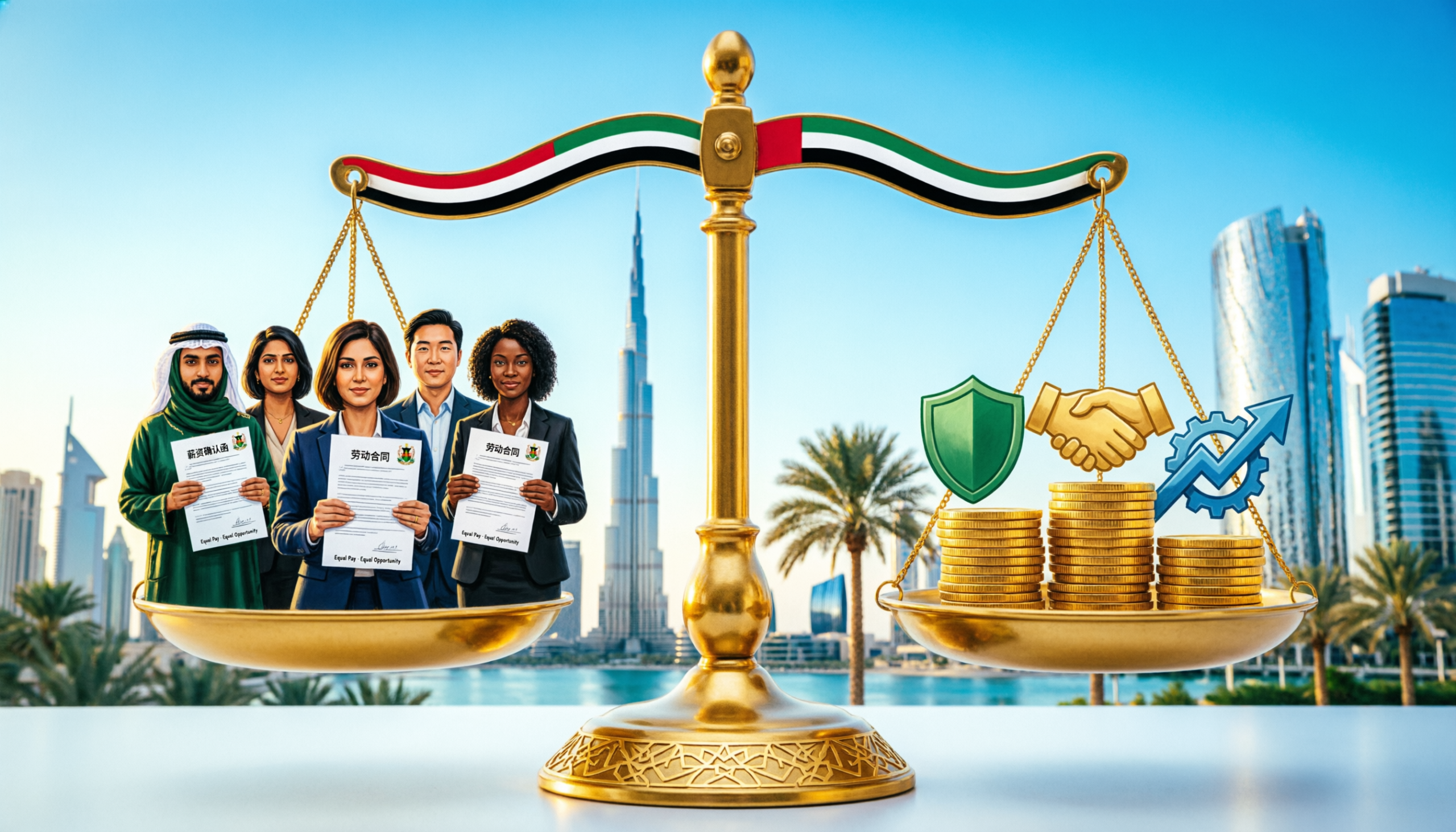
UAE revised its laws and adopted a modern approach for an equal salary structure to bring equality, justice, and impartiality. The modern salary structure is designed to offer equal wages to employees irrespective of their gender, caste, background, religion, or ethnicity. Article 4 prohibits discrimination in the workplace. It also states that a woman must receive a wage equal to that of a man when performing the same work or work of equal value.
How UAE Equal Pay Laws Promote Workplace Fairness
Legitimate fair wage employment laws are an initiative that brings up transparency, justice, and equality.
There are many different factors that contribute to wage discrepancy. UAE equal salary laws safeguard workers and employees against salary discrimination and bring impartiality.
Employers should develop their workforce infrastructure to ensure the rights of the workforce are preserved, irrespective of gender bias.
Employees, if they are facing issues and not receiving unequal pay or facing salary discrimination, should preserve their employment contract, job description, pay slips, performance records, and relevant workplace communications. An experienced UAE Labour Lawyer in Dubai can review the available evidence, explain the employee’s rights under UAE Labour Law, and assist with submitting a complaint to the relevant authority where necessary.
What Does Equal Pay Mean under UAE Labour Law?
The UAE has introduced an equal income law to ensure all employers are legally bound to pay fair salaries to their workforce. There are variables that contribute to the difference in wage rate, including experience, education, skills, and accomplishments.
The concept revolves around the goal that people with similar duties and obligations must be paid equally. There should be equal income for workers with the same level of work and performance. It includes the employee’s basic salary along with the benefits such as allowances, gratuity, and other recruitment perks.
The term similar work refers to equal job-related tasks within the same capacity. On the other hand, comparable work may be in terms of talent, authority, and ingenuity.
Why Equal Pay Matters in the UAE
Equal wages are a concept that boosts workers’ confidence and uplifts their motivation level. It also allows an organization to enhance the workers’ retention and reduce absenteeism from work.
Besides, it reduces the level of redundancy rate and thus assists business goals in a better way. With fair remuneration laws, the productivity of the employees may improve. As a result, it benefits the organization and its operations. It promotes a fair work culture that overall improves efficiency.
How UAE Labour Law Supports Wage Equality
The relevant authorities include:
- Federal Decree-Law No. 33 of 2021 for private-sector employment.
- Federal Decree-Law No. 47 of 2021 concerning unified general employment rules.
The authority provides the legal standing for wage parity in the UAE. Under the statute, the emphasis is placed on impartiality and accountability in all types of employment-related matters.
This law forbids prejudice based on sex. It suggests that all males and females working in the same workspace and capacity must be paid equally without any discrimination.
Gender Equality is the basis for the employment charter. It strongly opposes gender-based prejudice in the workplace. All employers are required to adhere to the law of gender equality for paying workers.
Application of Equal Pay Provisions under UAE Labour Law
There is a provision for fair pay present in the UAE labor law and the UAE Employment Charter. According to that, all the male and female workers who are performing similar tasks must get the same level of pay or wage.
Besides, this is a compulsory provision that must be followed. This statute is applicable to all private sector employment. This advocates for fair treatment for all workers in an organization. This law is applicable to all employees working in the private sector in the UAE. It is applicable to UAE natives and expatriates.
Equal Salary Protections for Private-Sector Employees
All private businesses and organizations are structured to adhere to the law. They are obliged to adhere to the principle of equal pay to ensure fairness and equality. The salary policy of the business must comply with the Equal Pay law.
The equal pay law should be part of the Human Resource Policy. The organization’s internal HR policies must reflect the fair wage rates. The law also demands regular audits in-house to have a check-and-balance system.
Fair Pay Structures in the UAE Public Sector
The public sector organizations have systematic and structured pay levels. This is a present that reduces the level of risk for unjust pay variation across various sectors.
Wage disparity is less in the public sector than in the private sector. The UAE public sector has a highly structured pay structure and, therefore, less discrimination is witnessed in various sectors, divisions, and departments.
Role of the Wage Protection System in Promoting Salary Transparency
The digitalization of the Wage Protection System (WPS) has further improved the prompt and timely payment of wages. It also helps in maintaining the transparency in precise salary payment.
It does not directly ensure income equality, but it does help in achieving income equality and ensures a fair payroll system within an organization.
Question Answers:
What is part of “Salary” as per the UAE employment Law?
Salary does not only refer to the basic salary or the compensation. It also covers all types of monetary benefits. It may include bonuses, grants, subsidies, remittances, and more. This refers to the complete salary package, not just the salary income for the month.
For equality, it is suggested to have similar benefits and allowances for workers. The factors impacting the decision should be fairly evaluated and paid fairly. Some of the key contributors are accommodation, transportation, commission, and more.
When may the salary differ among workers of the same organization?
Wage disparity is a normal phenomenon that is legal. The variation in the pay scale should be on solid grounds. Some of the key factors that impact the wage are skills, experience, credentials, competence, and more. Therefore, equality in every case is not possible. Workers with the same designation may get different salaries due to various reasons.
How to Deal with Unfair Treatment?
There are many lawful solutions available for workers to combat unfair treatment in the workplace concerning the pay scale. The employees can register a complaint against inequality.
They can file a petition with the help of a knowledgeable labor lawyer in the UAE. However, a professional attorney must be provided with evidence of unfair practices, recruitment contracts, and pay records in possession.

One thought on “UAE Equal Pay Law: Employee Rights and Employer Obligations”